A Moving Blog

Occasional celluloid musings from BarryG

Showing posts with label As-Ko. Show all posts

Saturday, 7 May 2011

Poetry

Only a well-subsidised movie industry such as South Korea's could fund a constant stream of sad feature films. They are cinematic joys for their pensive auteurs and angstful actors, and there must be healthy (numerically speaking) national audiences that also derive pleasure from them.


Poetry tells the tearful tale of a suburban-rural village where an ageing woman learns that she has Alzheimer's, and that the selfish grandson in her care is one of the local schoolboys whose regular rape sessions drove a schoolgirl to drown herself. Painfully aware of life's cruelties and its natural beauties, the woman joins a community class to learn about poetry. Its attendees promise to complete one poem by the end of the course. Only she does so, musing wistfully on the girl's death, having turned her grandson over to the local police and decided to kill herself.

Writer-director-producer Lee Chang-dong's mesmerising 2010 study hinges vitally on the lead role played by retired actress Yoon Jeong-hee, making her first movie for 16 years. She's won deserved Asian festival awards, as has Lee (and two at Cannes 2010).

Sunday, 2 January 2011

Daylight drinking

Road movies are a favoured genre for telling an episodic story that takes one or more characters from A to a life-changing B position. Original variations on that theme are difficult to imagine, and a novice South Korean director chose to follow a path taken in the USA by Sideways, finding truths through booze.


Young-seok Noh's Daytime Drinking is a one-man labour of love of movies on his first credited work - as its writer, director, cameo actor, cinematographer, music composer, production designer, editor, sound controller and producer! The end credits show that he'd employed various technical staff to back him up. Most important, he recruited an exceptional cast of acting unknowns.

The lead character is spotty-faced plumpish Hyuk-jin (Sam-dong Song), a young man just dumped by his girlfriend. His drinking buddies suggest they all cheer him up by going to a mountainous resort area for R&R and boozing. When he gets there, at the little-visited height of snowy winter, he learns they've abandoned the idea and he's on his own.

A series of mildly bizarre and/or comic escapades lead Hyuk-sin from one disastrous female to another, from robbers to sexual gropers, from hitching in his underwear to finally meeting up with the best friend who'd suggested the trip and has a good reason for feeling extra guilty. The only connection between everyone is the strangers' passion for alcohol, from cheap Korean soju plonk to local whisky and potent home brews.

Much of the time the camera simply sits in a visibly cold setting recording conversations that travel from bashful chitchat to despair, dipsomaniac farce or surrealistic drollery. Nearly a dozen richly detailed and well-acted characters, offbeat but entirely credible, cross the lost young man's confused path to nowhere, which ends up at the hopeful start of another bus journey into the strikingly harsh Korean scenery.

A small low-budget calling-card for the director, the movie is a charmingly modest first step for a director exhibiting no pretensions or wild ambitions.

Saturday, 17 July 2010

Good, the bad, the weird

Once upon a movie age, Italy, France and other Western powers of the silver screen produced generations of gifted directors. Then Japan did. It's been South Korea's turn for more than a decade, and it's fitting that Ji-woon Kim decided to make a tribute to Sergio Leone.


It wasn't called a "noodle Western", rightly. That would sound even blander than its "spaghetti" inspiration. Released in 2008, The Good, The Bad, The Weird is Kim's self-proclaimed "kimchi Western", a spicy recipe with a very distinctive flavour.

Its setting is Japanese-occupied Manchuria in the 1930s. Korean independence warriors are up there, and so are two Korean renegades, a bounty hunter, Chinese bandits, Japanese troops and Indiana Jones clones on horses, motorbikes and steam trains.

It doesn't really matter who is the Good (Woo-sung Warrior Jung), Bad (Byung-hun Hero Lee) or Weird (Kang-ho Thirst Song) Korean guy. This is a movie with the intellectual subtlety of early Clint Eastwood. All it wants to be is a technically immaculate Korean celebration of Hollywood's Western conventions and comics, from Keystone Kops to Star Wars, Mel Brooks to Spielberg. Kim apparently decided to honour all their international offspring too, from Mad Max to gun-slinging samurais to pirouetting Hong Kong kung fu acrobats.

The screen is constantly, frantically busy, elaborately set and costumed, and captivatingly choreographed so that every extra does something detailed rather than just filling space. "The money's on the screen", as Hollywood producers used to boast: if guns can blaze, bombs explode, cavalry charge, motorbikes race and eyes glisten, they will, in vibrant cinematography and surround sound.

After the movie's initial 20-minute train chase, when the camera's flown over the surrounding desert and in, out and round period carriages, and a massive tableau of crooks have been assembled on the train, then dispersed, each chasing an unidentified map for possible buried treasure, the audience has no idea where it's being led, or which character it's supposed to cheer.
The ending kills off one of the trio, and a sequel seems likely. Or not. It doesn't matter, because this is just a fun fest best devoured in a big-screen environment as a very high-class Saturday matinee treat.

Thursday, 15 July 2010

Oldboy

"15 Years of Imprisonment ... 5 Days of Vengeance". That was the movie's sales tag, and it's all anyone needs to know before watching Chanwook Park's Oldboy, the second (2003) feature in his so-called "Vengeance Trilogy".


This movie version of a manga "comic" book is a horror epic and its synopsis is mind-blowingly complex. In typical Park fashion, it's also shot through with scenes of outrageously noir humour. The Korean director's black artistry is as polished as ever, gleaming like evil gems adorning sets that are exquisitely composed, framed and lit.

The two lead actors perform their bizarre roles well, as old boys of the same co-ed Catholic school. One, drunken buffoonish Daesu Oh (Min-sik Choi) is kidnapped when his daughter' three years old. For 15 years, he's held prisoner and then allowed to go free, given five days to find out why he'd been confined and seek his revenge. He's introduced to a young female sushi chef, eats a live octopus at her counter, faints and moves into her apartment and love-life.

The other schoolboy, Woo-jin (Ji-tae Yu), is eventually revealed. The scheming millionaire brother of a girl who died at their school, he too is seeking revenge, in ways even Macchiavelli might spurn.

Now, spoilers are spilt. The brother and sister loved each other, perhaps incestuously, and the ex-prisoner is the father of the girl, whom he'd been accused of killing. Double incest is an unusual basis for a melodrama, horror film and fantasy, and I cannot imagine how - or why - an American version of this movie is in production.

The original plotline could never get a green light in the USA. A dozen key, gruesome and gory plot details will have to vanish. Another dozen red herrings, macabre footnotes and mood enhancers won't survive the film's first American production conference. On second thoughts, one cannot wait to see what happens to this scenario in its American reincarnation.

The multi-award-winning Korean movie earned the Cannes Jury Grand Prize and is admirable. So, some people think, is sado-masochism.


Tuesday, 13 July 2010

Sympathy for Mr Vengeance

Sympathy for Mr Vengeance [MV] was the first of three films in the "Vengeance Trilogy" from South Korean director Chan-wook Park. His fifth feature, it appeared in 2002. Old Boy [OB] followed the next year, and Lady Vengeance [LV] in 2005.


Park is a unique talent, and it's indicative that the only special feature on the DVD of MV is a sequence of story board sketches outlining the highlights of the ultra-violent movie.

In the movie, even in the goriest most shocking incidents, the aesthetics of the storyboarding are clear, in Park's meticulous composition of each scene's colour balance, lighting effects, off-screen sound effects and actors' ensemble poses. Early in MV, in the steel factory where Ryu (charismatic Ha-kyun Shin) the deaf-and-dumb anti-hero works, splashes and lines of green decorate the set. They were designed to complement Ryu's green hair dye.

The whole film is so artfully self-conscious, one knows that the seemingly chaotic jump cuts in the storyline must also be deliberate. Frequently, the audience is forced - deliberately alienated, I'd guess - into seeing a character or a plot development as both inexplicable and unrealistic.

If Park's quartet of screenwriters, including himself, were creating social melodramas, an audience might sneer at such cinematic conceits. When the scenario bristles with deep black humour and shocking moments of gore and sadism, a viewer is forced to drop his jaw and gape in disbelief. Park is Hitchcock on a much higher, riper level, at times almost sickening, always engrossing.

Can a mass masturbation scene be a comedic triumph? Has anyone ever used bottles of urine to mark the passage of time? Can the ghost of a kidnapped girl be shown to make her grieving father (another bewitching Park regular, Kang-ho Song) laugh? Can we wait ten minutes to guess why the anti-hero has a gash in his stomach?

The basic story is simple. The deaf-dumb man and his revolutionary-anarchist girlfriend kidnap a rich man's daughter to raise money for an organ transplant for the man's sister. A mentally retarded stranger, akin to Lear's Fool, stumbles by and the girl dies accidentally. From then on, revenge is rampant, blood seeps and teems, and the framing of each scene remains mesmerising evidence of a very disturbed cinematic genius.

Genius, yes, because there are few movies that compel a viewer to seek out their sequels, fewer that demand replays in order to see the creative methods in the seeming madness.

Friday, 7 May 2010

Mother

It is possible that the Korean movie Mother proved to be so admirable because few other films in the past year have shown the same high levels of scripting, cinematography, acting and audacity. By comparison with what appeared before, Bong Joon-Ho's latest work of arts and craftiness is a work of genius. Together with The Host, it confirms his status as an auteur with commercial flair.


He conceived a simple storyline. A mentally handicapped young man has been taught by his over-protective mother to react fiercely if anyone calls him a retard. He's the local police stations' obvious culprit when a schoolgirl is found bashed to death. Mother, aided by gossipy schoolchildren and paid-for advice from her son's criminal pal, sets out to prove that someone else murdered the girl.

Out of a such a hackneyed concept, Bong created a perversely witty black comedy slyly transformed into a quirky Hitchcockian thriller. His key ingredient is the multi-award-winning lead actress, Kim Hye-ja, a mesmerising screen presence as an impoverished mum who's an unlicensed herbalist. Whenever she's not in focus, the audience gains a better chance to note how brilliantly, yet unostentatiously, every scene has been framed, composed and edited.

The son's simple-minded, easily side-tracked and confused character is presented credibly, yet he's rarely shown as deformed, mentally or facially. His amoral pal is given a fascinating complexity, as a buffoon, incompetent schemer, sexual object and evil force. Other roles are off-beat cameos, adorned with bizarre quirks that enliven the script and action.

This is a film also rich with visual and soundtrack details that subtly heighten scenes' atmosphere and tension. Acupuncture needles, a smashed apple, detectives' swivelling heads, a field for dancing, guillotined herbs, and more cinematic magic await discovery on a future viewing. Which there will be, which makes this Mother such an unusually welcome movie.

Saturday, 13 February 2010

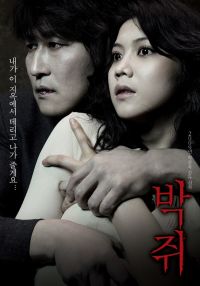
Thirst

Why do so many otherwise normal people like to imagine having their blood sucked out of them? Just thinking the thought gives my skin a faintly thrilling frisson, and I'm definitely otherwise as normal as can be. Except for my fetish for wordplays like the effing one in the previous sentence. Its proper name might re-enter my memory momentarily, maybe ...


Be that as it may, the Korean box-office champion of 2009, Thirst, deserves serious attention (and its 2009 Cannes Jury award). It's a simple tale of a Catholic priest, a fairly common character in Korean life and movies. This time he's an orphan, and volunteers as a guinea-pig for a medical clinic testing vaccines for a deadly virus. The sole survivor, he returns to his Korean parish to discover that his leprous outbursts can only be repressed by drinking human blood. French cineastes will smell a Zola novel being re-worked.

Give such a standard vampire scenario to a good director (Park Chan-wook), scriptwriters (Park and another) and lead actor (Song Kang-ho) though, and a remarkably successful exercise in dramatic surreality and black comedy is created. There is a supporting cast of Grand Guignol, yet credibly human, characters who take the doomed priest into their home and hearts -- an evil-natured megalomaniac schoolmate and his doting dressmaking mother, woefully-abused and morally-challenged wife and their household's innocent Filipina amah.

The storyboard cuts from incongruity to illogicality, comic horror to thwarted love, always surprising its audience with unexpected camera angles and shocking character insights. Dead people re-appear, a paralysed woman stares melodramatically, suppurations blossom and fade. Everyone thirsts for something extra, for mahjong wins, divine touches and eternal love.

As vampire-movie cognoscenti know, the sun always rises. Brilliantly, dramatically, black-comically, in the parched scenes of Thirst's startling ending.
[Back at the beginning, in case you didn't know before I did -- I'd mislaid "alliteration". I've often found that when I play with words, I lose at least one ...]

  © Free Blogger Templates 'Photoblog II' by Ourblogtemplates.com 2008

Back to TOP